
SKID STEER LOADER GRAPPLES: TYPES AND AREAS OF USE
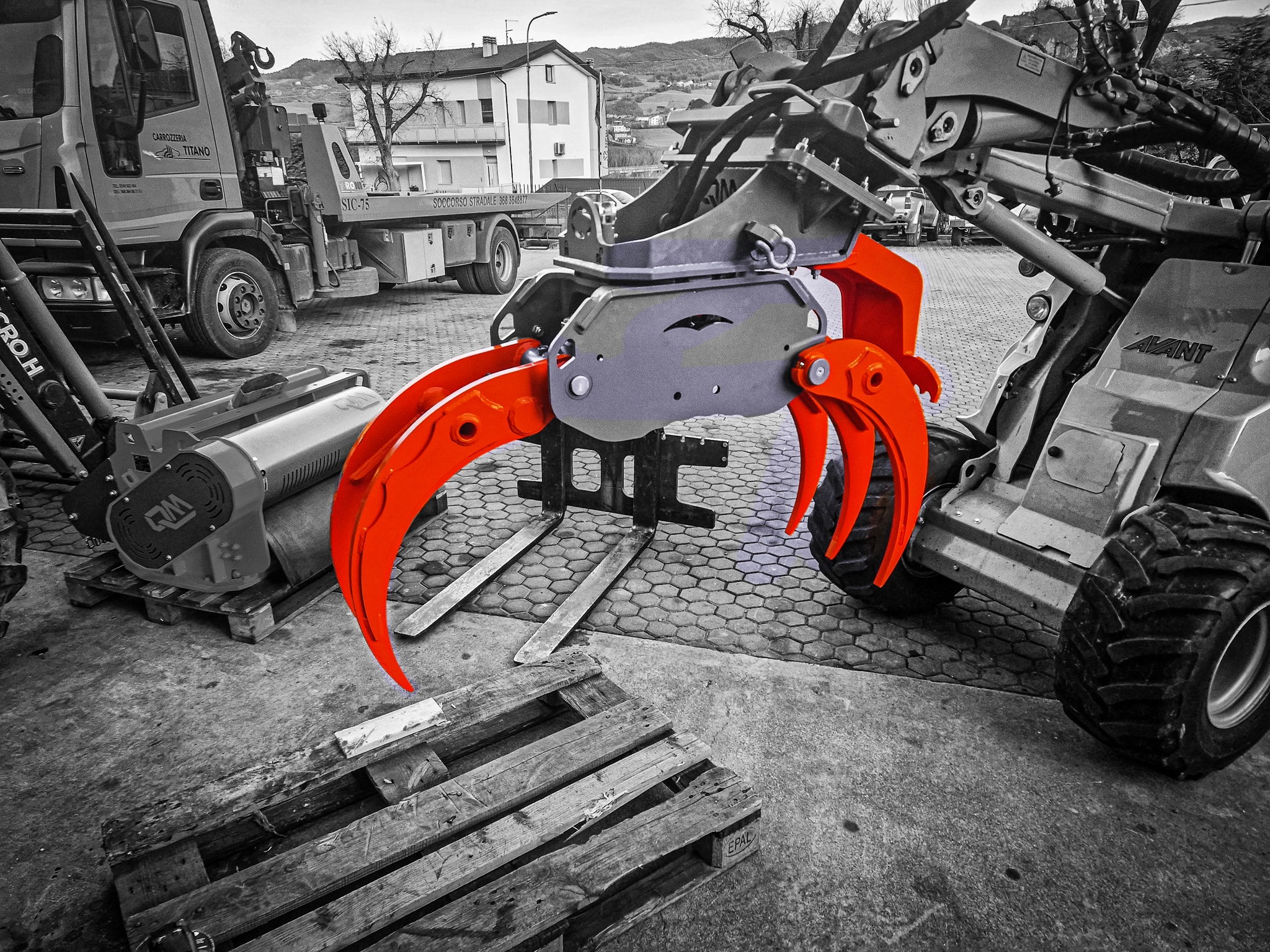
When it comes to skid steer loader grapples, it is appropriate to make a good distinction between the different types. In fact, there is not uniquely a macro class of grapples, but it is possible to classify them into a couple of categories: swing-mounted and rigid-bracket.
Types of skid steer loader grapples: differences
The main difference between a swing-mounted skid steer loader grapple and a rigid-bracket grapple concerns how the grapple is attached to the machine and, consequently, how the machine behaves in the course of work.
Anticipating the conclusion, let us say that an oscillating grapple offers broader operational flexibility and greater adaptability than its rigid alternative. It is therefore ideal for uneven terrain and work requiring more precision.
The rigid grapple, on the other hand, certainly appears simpler and more robust. Preferable in operations involving more uniform soils and where more force is required for handling.
Swing clamps
They make use of a movable joint that allows some degree of passive rotation.
They are, in general, lighter and designed to work exclusively in a position perpendicular to the ground. In this position, which is ideal for being able to express the best characteristics, they also operate accurately, providing a good quality of final work.
The joint requires more height clearance and makes them less compact. They are suitable for less heavy-duty uses.
Main features: the gripper is connected to the machine through an oscillating joint, which allows an oscillating motion, between the gripper and the machine itself.
Benefits
- Increased flexibility and great ability to adapt to uneven terrain.
- Improved aptitude for working on uneven surfaces, facilitating gripping operations.
- Reduction of stresses on the machine frame during the operational phase of work.
Disadvantages
- Structurally lighter caliper
- Greater overall height of the clamp
- Requirement for increased maintenance of the oscillating joint.
- Not for heavy-duty use.

Rigid Clamping Pliers
They provide for direct, swing-free mounting. They are more compact and sturdy, suitable for demanding forestry or agricultural work. They also provide more control, precision and strength when handling heavy materials.
Main features: the clamp is fixed through a rigid connection to the machine, with total absence of oscillating movement, but with a fixed connection.
Advantages:
- Simpler and more robust structure.
- Less maintenance than an oscillating clamp.
- Improved accuracy during excavation or material handling operations.
- Lower overall height of the clamp.
- Disadvantages:
- Less adaptability to roughness and unevenness of the ground.
- Increased stresses on the machine structure and the clamp itself.
Areas of use for skid steer loaders
The use of skid steer loader grapples is indeed very diverse and on a large scale. On the one hand, this aspect, returns to the operator a vast scope of use for this important accessory, which is very versatile and functional. It also leaves the user with a fair amount of creativity in use, as intense as the search for possible uses in which the grapples can be excellent and decisive prehensile organs.
Some contexts of use for skid steer loaders
- Handling of cut timber: Loading and unloading of logs, bundles, stumps and brushwood in forest or agricultural settings.
- Forest and undergrowth cleanup: removal of material following cutting, pruning or felling.
- Biomass and firewood collection.: moving, preparing, and organizing woody material for shredding or storage.
- Roadside and embankment maintenance: work on unsafe trees, brushwood, debris in riverbeds or on the banks of reservoirs, or removal of fallen trees.
- Nursery and plantation management.: moving logs, poles, stump, voluminous pruning residues.
- Use on small construction sites: moving and handling construction lumber, beams, and similar materials, as well as moving debris or waste materials.
- Loading of chipping and material shredding plants: mechanical feeding of chippers, shredders, composting and recovery plants
QM’s grapples for skid steer loaders and miniloaders.
The range of grapples that QM offers is wide and can cover all the main needs of “amateurs” and professionals in forestry, agriculture and forestry.
The products in question range from wood grapples, to the unique NEXOCLAW series of front-end gra pples for miniloaders and skid steer loaders, to the IMEX700 steel forestry grapples with 100% optimized shaping to prevent the collection of unwanted material.