
SHREDDER HEAD MAINTENANCE GUIDE
Maintenance of flail heads is essential to ensure efficient operation and prolong the life of the equipment, while also ensuring perfect cutting efficiency and thus the work done. Often these are fairly simple maintenance operations that should be part of routine, falling even within the “routine” of those who are not particularly experienced.
How to maintain the trenches?
Obviously, for those who are not very familiar with this area, not everything is doable on their own, but if proper care and attention is given, it is possible to ensure at least the minimum suggested to preserve the efficiency of shredding heads.
Why to do maintenance on trenches
Understanding the relevance of mulcher maintenance operations, it might be useful to explore the topic further, explaining why taking care of the implement is of paramount importance.
- Operational efficiency: a well-maintained mulcher operates more efficiently, ensuring uniform cuts and reducing downtime.
- Equipment life: regular maintenance helps extend the life of the machine and equipment, preventing wear and damage that could lead to costly repairs or the need to replace the entire attachment.
- Safety: a malfunctioning mulcher can pose a risk to the operator and to people working in work areas. Maintenance helps ensure that all parts are in good condition and properly functioning, while also keeping the safety systems in the machinery effective.
- Quality of work: working with a mulcher in good condition leads to better operational results through higher quality work. A sharper, sharper cut is essential in many areas and can be crucial in the total shredding of material to be removed as plant waste.
- Reduced costs: constant maintenance can extend the life of the equipment’s mechanical parts, reducing the likelihood of any extraordinary maintenance work that could be very costly. In the long run, therefore, overall operating costs will be lower, limiting sudden breakdowns and costly repairs.
In summary, maintaining flail heads means ensuring performance and safety, reducing expenses in the long run, and optimizing work.
How to maintain flail heads?
It is certain that care is needed and it is good to spend a few minutes on the head after it has been used, before storing it and preparing it for its next use. Here are some useful tips for maintaining flail heads.
Periodic visual inspection
The first thing to do is within everyone’s reach: take a general look at the equipment. It is necessary to check the headstock for any visible damage, such as cracks, or excessive wear. Spending a couple of minutes checking the blades, checking their sharpness and integrity is always a wise operation, to be done with a pair of work gloves and with the mulcher disconnected from the machine, when cold. A look should also be taken at the safety devices.
Cleaning operations
It is important to remove cutting debris that is caught between the blades, such as small wood, grass, shrubs, soil or small stones. The use of a pressure washer could help, as could that of compressed air, as long as you wear protective goggles and operate in an area without the presence of other people nearby, to prevent some of the debris from hitting those nearby. For more thorough washing, water and a nonaggressive detergent (such as laundry soap) are recommended.
Blade check and replacement
Sharpening blades is not for everyone, so it is best not to improvise. In fact, blades are generally not sharpened but replaced as they also shorten due to wear and tear. Not least, it should be considered that forestry tools have a braze-brazed carbide coating, while all others are made of a special heat-treated steel and are difficult to sharpen anyway. Therefore, it is better to proceed with the replacement of blades when they are worn and smaller in size than at the beginning. It is not possible to establish a standard period a priori; it depends a lot on usage, the terrain in which you work, and the type of work.
Verification of components
Joints, bearings, hydraulic lines, seals, are all components that need to be checked and lubricated, or replaced if the need arises or when indicated by the manufacturer. We also recommend a check to screws, fasteners, nuts and bolts that, in the long run, could loosen, cause harmful vibration and breakage.
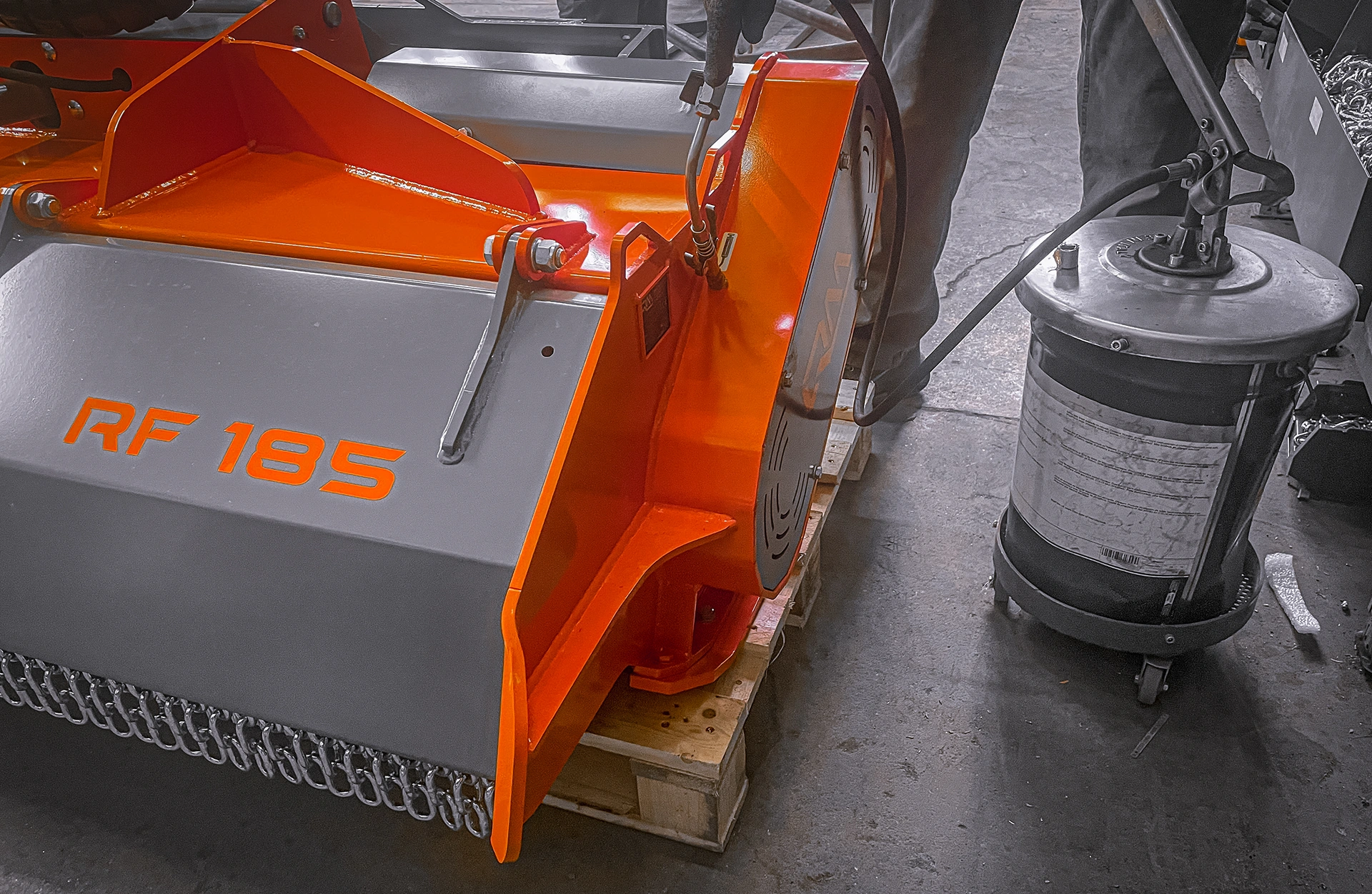
Lubrication
In different equipment, and therefore also in mulching heads, there are parts that need to be lubricated regularly, respecting the manufacturer’s specifications regarding the periodicity and type of lubricant to be used. Lubrication should renew every 8 to 10 hours of operation, but it depends greatly on the conditions of use and the type of mulcher.
Lubrication control
It goes without saying how important the transmission components should therefore be in order to make the whole cutting system work at its best. Belts, over time wear and tend to take on “play,” loosening up. In addition, moving parts may not run as smoothly as they could or may encounter obstacles. Careful inspection is strongly recommended: tightening a few screws, pulling the belt, releasing a moving part today, means avoiding a heavy breakage tomorrow.
Storage
The advice is to store the shredding head in a protected place, preferably inside, with its cover on and clean, so that it is ready for later use. Before setting the equipment aside, you can also spray the blades with a light coat of spray lubricant, which also acts as an antioxidant protectant.
Conclusion
Maintenance operations on flail heads should always be carried out with proper personal face and hand protection, including wearing safety shoes to safeguard the feet. What is expressed in this guide is also valid for maintenance to skid steer loaders, as well as for other types of mulchers.
By following these guidelines and matching our advice, it will be easier to keep chopper heads in top condition, confirming high performance and safety while working.